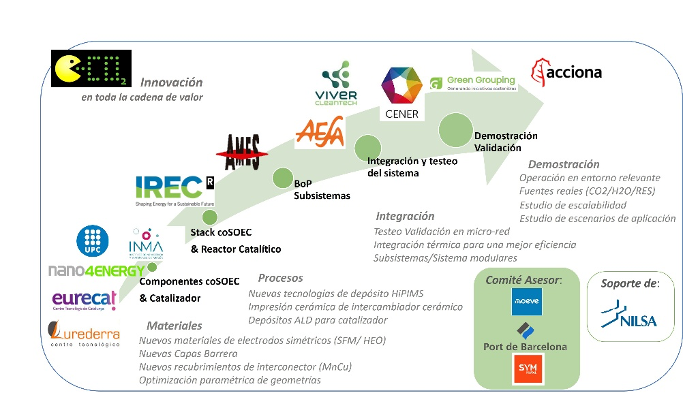

WHAT IS COMECOCO2
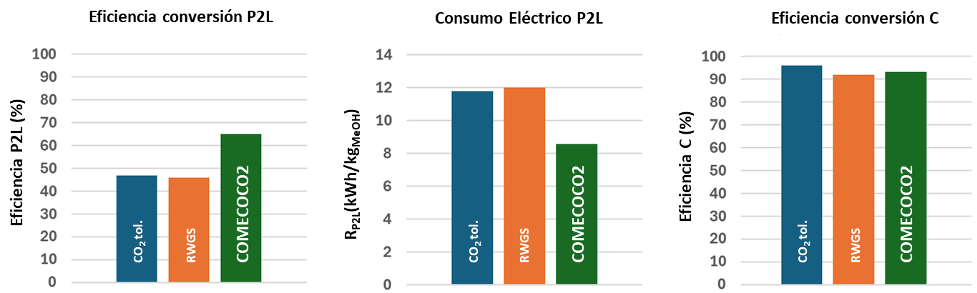
The high efficiency of both processes, combined with their efficient thermal integration, enables a significant reduction in the energy demand and production cost of methanol. At the same time, the use of advanced materials and manufacturing processes improves the system durability and tolerance to contaminants in the feedstock, while reducing the use of critical raw materials.
POWERING THE FUTURE
OF RENEWABLE METHANOL
+ 100
PAPERS
20
PARTNERS
25
MEMBERS
The Global Challenge
The transition to a low-carbon transport system is one of the major challenges of energy transition. While electrification and hydrogen can provide effective solutions for many applications, sectors such as maritime transport and aviation remain particularly challenging to decarbonize because of their high energy demand, long operating ranges and the limitations of current zero-emission technologies.
This is where renewable fuels can play an important role. Power-to-X (P2X) technologies make it possible to convert renewable electricity into chemical products that can be stored, transported and used as fuel. Among these, renewable methanol is gaining increasing attention as a versatile solution for reducing emissions in hard-to-abate transport sectors.
Methanol has several characteristics that make it particularly attractive. It is liquid at ambient conditions, making it relatively easy to store, transport and distribute. It can be used in internal combustion engines, including dual-fuel systems, as well as in fuel cells. Beyond its direct use as a fuel, methanol can also serve as a building block to produce other synthetic fuels, including sustainable aviation fuels through methanol-to-jet pathways.
The growing regulatory drive towards lower-emission transport is further accelerating interest in renewable methanol. European initiatives such as FuelEU Maritime and ReFuelEU Aviation are supporting the transition towards sustainable fuels and creating new opportunities for renewable alternatives to conventional fossil fuels.
Our GOALS
Development of a new, efficient and competitive pathway for renewable methanol production based entirely on technology developed and manufactured in Spain.
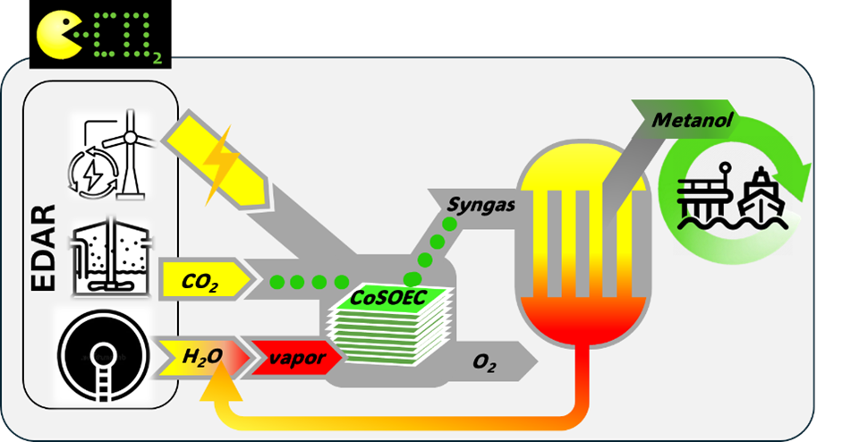
Combine renewable electricity, captured biogenic CO₂ and regenerated water to produce green methanol through an innovative Power-to-Liquid (P2L) process.
Increase process efficiency and reduce the energy requirements and production costs of renewable methanol.
Reduce the use of critical raw materials through the development of advanced materials and manufacturing processes.
Enable scalable and modular production of renewable methanol close to sources of biogenic CO₂.
OUR APPROACH
High-temperature co-electrolysis
Catalytic methanol synthesis
Circular feedstocks
Advanced materials
Thermal integration
EXPECTED PROCESS PERFORMANCE

COMECOCO2 TARGETS
- >65% overall P2L efficiency
- <9 kWh of electricity per kg of methanol
- An estimated production cost of approximately €0.53/kg of methanol
- 74–87% less use of critical materials, including rare earth elements, cobalt and nickel
- Approximately 10% additional performance through the integration of the co-electrolysis and methanol synthesis processes.